1. Special Education Class at な中 is only 5 students strong, three girls and two boys. They have varying degrees of affliction, but are pretty high functioning. They just need a separate class period a couple times a day. Sometimes, I attend the class with Mother Sensei and we do a simple English lesson together. It usually involves playing games with picture cards ("Karuta") for 20 minutes or more.
But yesterday was different. I went to the class with Mother Sensei and was greeted by their broad, genki smiles. Today was for practicing actions like "walk," "eat," "open," "close," "stand" and "sit." After some drilling, we played Simon Says...
...at one point I had the students stand up then eat and they all stood still despite the fact Simon had clearly Said. Mother Sensei laughed and applauded them for good manners. In Japan, it's usually rude to stand and eat (though there are exceptions for matsuri food and train station ramen stands) and the students were showing me how well-mannered they were!
After Simon Says, they were getting a little distracted. I'm still a novelty to students, so they're always full of questions. Yesterday, Mother Sensei decided to indulge them after one student asked if I could speak Japanese and I said "Sukoshi dake" (Only a little).
They decided to test my Japanese. Mother Sensei would give me an English sentence and I'd translate it to Japanese. It was pretty simple stuff ("My name is Marta." "I like ramen." "I come to school by car.") and the students got a kick from it. Then they asked questions in English with Mother Sensei's help and I answered in a little English and Japanese.
Then one student wanted to know if I could write kanji. I wrote on the board "私はマルタです." Applause all around. Then they wanted to know my favorite kanji...that's a thing, apparently. So I wrote "私は(森)が好きです." But I wrote "suki" wrong and the students helped me fix it. For 50 minutes, we just talked in Japanese and English, teaching each other.
Friday, October 31, 2014

Monday, October 20, 2014
Giddyup, Japan Style
So yesterday I hiked for about 4 hours, meaning I don't feel the need to go for a freezing cold jog. Also, I don't have to prepare any lessons for tomorrow. Additionally, I'm currently waiting for a mess of video files to convert for a project. All of this should tell you I have a ton of free time on my hands so I can do all kinds of useful things...
Like updating my blog!

Let's talk about awesome things for a second. Horses, they're pretty awesome. In some places like rural America, rural Japan, rural anywhere that horses are domesticated, they're still the primary power source on small farms. Horses are also athletes, running in races like the Triple Crown and also dancing unnaturally in the ridiculousness that is dressage. (That's about as white collar as it gets. "Hey, I have a $9,000 beast of strength and kickass. I'll make it dance to "These Boots Are Made for Walkin'.") Some countries still use horses as their primary mode of transportation.


 See "Seinfeld" episode "The Pony Remark."
 I may be horribly out of touch with Poland's current state of affairs, but from what I know, this seems a logical leap.
 Anyway, horses are pretty great. They're not rocket scientists by intellectual standards, but hey, they're horses. What do they need rockets for?
Now, archery. Archery is also rather, really, totally awesome. One of the oldest forms of killing something and watching the light leave its eyes from some distance, archery has shown itself to be pretty freaking cool throughout history. The Mongols (Genghis Khan's clan, to name names) were some of the first to actually start shooting arrows at targets from horseback. That takes some serious skill: taking your hands off the reins, drawing a bow which requires considerable abdominal and upper arm strength, aiming from the swaying back of the machine beneath you and actually hitting something.
Yeah, hardcore.
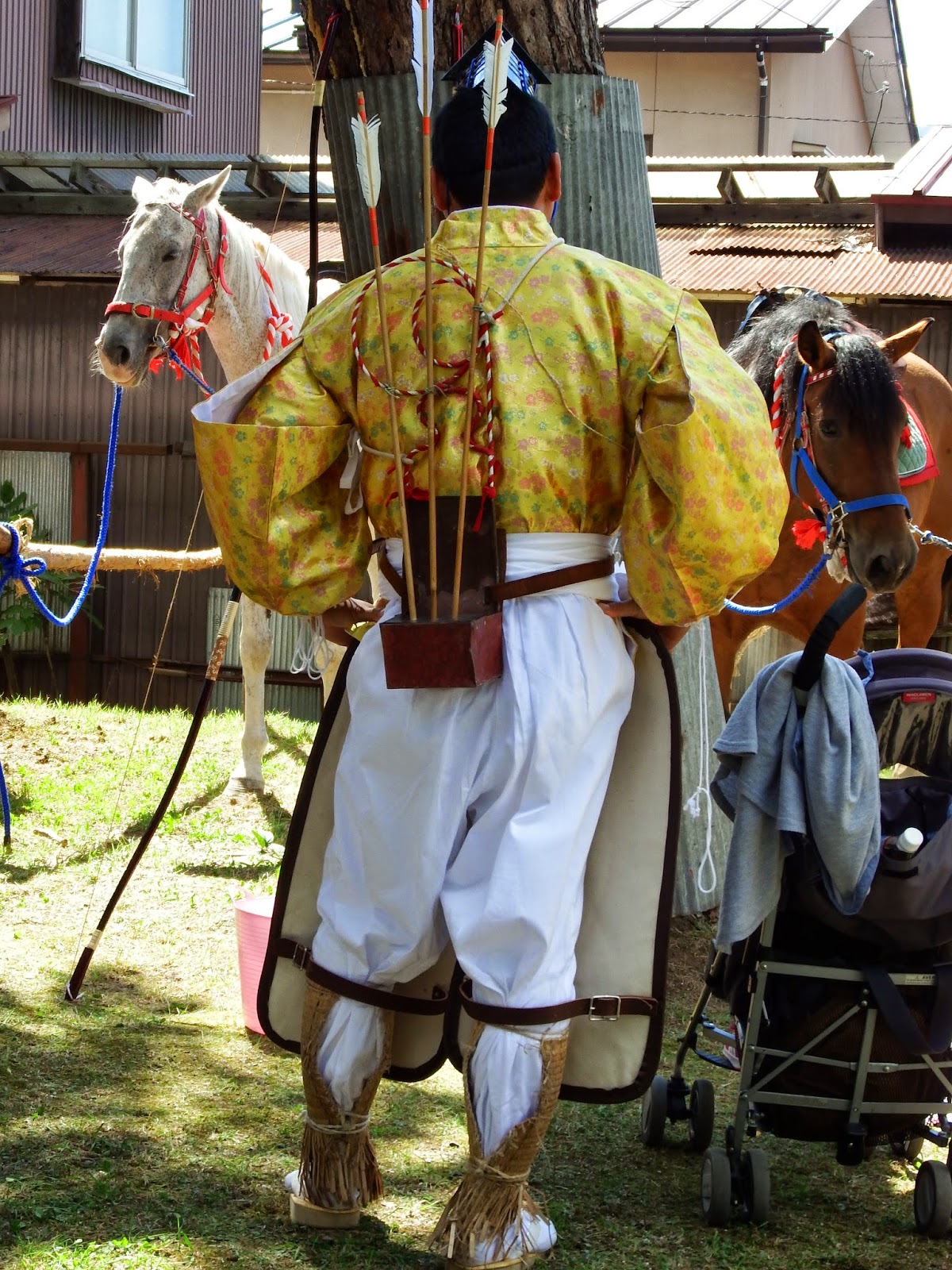 Japan also has a long history of horseback archery, or "yabusame." It all started in the Kamakura Period, (lasting roughly 1185 to 1333) when shogun Minamoto no Yorimoto was appalled at the lack of archery skills in his samurai. So how did he decide to spruce up the troops? Tasking them with learning archery ON A HORSE.

That training came into use during the Genpei War between the Minamoto and Taira shogun clans. At the end of one battle, the defeated Heike clan retreated from the Genji and took to their boats. The Genji pursued them on horses, but were stopped by the sea. The boats floated offshore waiting for favorable winds. As a sign of their "chivalrous rivalry," someone on a Heike boat hung a paper fan on a mast and challenged a Genji to hit it with an arrow.
 One Genji rode his horse into the water, took aim with his long Japanese bow and shot the fan right through. It's still a well-known event today. So well-known that it's a common late summer festival event all over Japan.
 I went to a yabusame festival in Tono last month. It was a great day trip and I definitely got a feel for the history and the excitement that the festival is all about.

As each rider raced down the track and shot the wooden targets, the crowd's collective voice rose, roared and cheered!
 Immediately behind the archer, a retainer in blue rode with his arms outstretched. He'd turn sideways in his seat for every target hit. It's an interesting way to tally the score since the track is long and it'd be difficult for the judges to see the targets at both ends.
Like updating my blog!
Let's talk about awesome things for a second. Horses, they're pretty awesome. In some places like rural America, rural Japan, rural anywhere that horses are domesticated, they're still the primary power source on small farms. Horses are also athletes, running in races like the Triple Crown and also dancing unnaturally in the ridiculousness that is dressage. (That's about as white collar as it gets. "Hey, I have a $9,000 beast of strength and kickass. I'll make it dance to "These Boots Are Made for Walkin'.") Some countries still use horses as their primary mode of transportation.
Now, archery. Archery is also rather, really, totally awesome. One of the oldest forms of killing something and watching the light leave its eyes from some distance, archery has shown itself to be pretty freaking cool throughout history. The Mongols (Genghis Khan's clan, to name names) were some of the first to actually start shooting arrows at targets from horseback. That takes some serious skill: taking your hands off the reins, drawing a bow which requires considerable abdominal and upper arm strength, aiming from the swaying back of the machine beneath you and actually hitting something.
Yeah, hardcore.
As each rider raced down the track and shot the wooden targets, the crowd's collective voice rose, roared and cheered!
Tuesday, October 7, 2014
What Spiders Have Taught Me
It's October, so what better time to write about something scary?
Spiders, as anyone with a frontal lobe can tell you, are
creepy. They are creepy as hell. I’ll be clear, though and say that yes,
there’s a difference between something being “creepy” and something being
“scary…” though sometimes, it can be both. Spiders are a great example:
Spiders scare the living hell out of me.
Spiders are creepy little monsters full of fun little
surprises.
I didn’t used to be afraid of spiders. Not really. But when,
in elementary school, we talked about what we were afraid of, the number of
girls scared of spiders sort of gave me the impression that I was supposed to be afraid of them. Seems
silly now but after years of dodging webs and a few nights where I’ve woken
with a spider tap-dancing on my face, there’s no going back.
And god help the spider that pops in on me unexpected. I
don’t like killing spiders, but instinctive fear is a blood-thirsty juggernaut
and I’m not about to stop it.
My arachnophobia is the Mr. Hyde to my Dr. Jekyll. That
said, I do respect the little beasts. They have their own sort of magnificence:
they’re perfect in that they always do their jobs (Gil Grissom said the same of
bugs, but I feel it’s apt here, too) and focus single-mindedly on the task at
hand.
You never see a sweet article about a new litter of baby
spiders or a cute video of spiders cuddling. If there’s a spider involved, it’s
doing something spine-chilling like being in multitude. Spiders are not
sentimental. They are prolific, determined and beautifully methodical.
I was on a train platform late one night last summer. I
looked up above my head to check the clock and noticed to my initial horror, a
large brown spider. I was a little nauseous at first, but as I watched in
disgusted fascination, I noticed it was working on a new web. I was hypnotized
watching this spider crawl around and around, pulling that thread from its own
body and making a beautiful but temporary death trap.
For that’s the thing about webs: they’re impermanent. They
do their job a couple of times, then disappear completely. They’re meant to
catch the spiders’ food, then be destroyed. And yet, for all their
impermanence, they are still breathtaking. A spider is like the greatest
artists who actually put a bit of their self into their work. I remember researching an American Indian and artist who, after learning he
was diabetic, used some soda and his own diabetic
blood to paint a still life portrait of a skull.
Sometimes, I can’t believe the scale of webs. So big, they
still serve the primary function, but the audacity of their size is sometimes
too funny. I’ve seen webs over front doors, across roads, and under bridges.
These are spiders reaching for the stars and landing in a black hole of
“Never-Gonna-Happen.” Like novices aiming for prestige with no talent to back
it, they’re the American Idol contestants we watch just to see how badly
they’ll crash and burn.
But the spider doesn’t care. It know this is only temporary,
that every opportunity is short-lived and imperative. The spider is not a
defeatist. If anything, it’s an optimist. Keep on dreaming, you little shit.
But spiders are just as diverse as any other species. There
are small spiders that make large, sunlit webs, and there are darker more
creepy spiders that hide in dark spaces and set traps. Brown recluse, black
widow, wolf-spider: each one appropriately named to invoke fear, hatred and
queasiness. They’re also the most deadly. They’re toxic and they know it, clap
your hands. But they use their horrifying talent in their own defense or to get
their own food.
You might blame the spider for biting you, but you put your
hand in its happy little hidey-hole. In all fairness, you were intruding, not
the spider. The spider didn’t know you were feeling nostalgic and felt like
crawling around the attic for the first time in years. It didn’t know you were
going to grab that one log for a fire. In the world of “fight or flight,” the
spider is a devoted and ready citizen.
Scarier still are the beasts of the deepest, darkest wild,
like Australia, where “dinner plate” and “bird-eating” spiders are the horrifying
norm. Names like that are enough to make me throw my hands up in defeat and
walk into the ocean. But you have to gaze in disgust and awe as a spider the
size of a Chihuahua leaps up and catches a robin out of the air! They have
evolved to literally take down an animal that would normally eat the spiders
own (smaller and thus more pathetic, the “bird-eating” spider would smugly add)
kind. They are engineered to turn the tables on another would-be predator. In a
world where bird eating spiders exist, I look at JRR Tolkein’s Shebol and JK
Rowling’s Aragog and think, “You know what, I could see that happening.”
And you know what? Good for the spiders. As humans, we’ve
evolved and made incredible strides to become a formidable opponent in the
natural world. Why not give some credit to another species that has done the
same? I’ll still keep a rolled up magazine handy, but let’s just say I’m
helping our mutual species advance.
Sunday, October 5, 2014
Plump: Picture Lump!
 |
| Hotto Yudo station and onsen in Nishiwaga |
It's fall! Or as my European friends would put it, "Autumn." Whatever you call it, it's finally here! The heat has broken and the Japanese are eying the trees waiting for the leaves to peak to their most brilliant.
 |
| Will, you got something in your teeth... |

 |


And of course, Fall is just beautiful for doing what it does naturally.
 |
| I woke up like this! |


Tuesday, September 30, 2014
Pancake Epiphany...and Shinjuku
It took far too long than necessary for me to get from Kyoto
to Shinjuku, but I’ll spare the details and say that after getting on the wrong
train twice and back-tracking far more than I should have, I arrived in muggy,
rainy Tokyo with sore feet, an aching back and about 8 hours to kill before my
night bus to Sendai.
Every locker at the station was full, so lucky me got to
walk around with my entire trip on my back. Fortunately, Shinjuku is
interesting and busy enough to keep your mind pre-occupied.

For example, robot girl battling is apparently a thing...a very popular thing.

I saw plenty of the street art and fashion that the area is
known for, and even popped into a few famous stores. I made a real nuisance of
myself in the enormous and very cramped Don Quixote store. The building has
five floors, and they all are just jam-packed with a wide variety of everything
imaginable. Designer bags and shoes, home appliances, toys, gag gifts, tech,
gear, snacks, music, clothes, cosmetics, luggage and more, just stuffed in to
the ceiling! I shimmied my way through the shelves and racks and indulged in a
few little items like a Bath and Body Works Minty Foot Scrub (hey—I was looking
forward to a little pampering after this trip). And hey, anything from Bath and
Body Works for under 20 bucks is a freaking miracle. My scrub was just 700 yen!
Yeah, let that settle.

As the sun went down and the neon lights came up, I was starting to feel seriously under dressed. There is some amazing and edgy fashion in Shinjuki: everything you've heard is true. I had read about a shop in the area that sold cute fashion corsets, so I went looking for it thinking I could just change there and wear it out. Unfortunately, the place I'd read about wasn't in the right location. So instead, I found a plaza and propped myself against a rock to rest and people watch for a bit.

That's when the creep found me.

At first, he'd just doubled back to say hello and then we were conversing in Japanese/English. It was fine, but this middle-aged man kept commenting on my eyes and even my body, asking if I had a boyfriend.
Obviously, I lied and said "Yes, and he visits every month." He also kept licking his lips or sticking his tongue out the corner of his mouth. For all his business attire, he was seriously gross. He actually suggested (seriously? jokingly?) that he could be my Japanese boyfriend (lick) and told me he loved me (lick). Finally, I told him I had to leave and meet my friend in the station. He offered to buy me dinner but I just said no thanks and walked away...only because my bag was too heavy for me to run.

Maybe you’re thinking I should have just laughed it off,
that he couldn’t possibly be serious…but is that just a common way for
middle-aged and older men to talk to young women here? Because it happens
EVERYWHERE! And maybe I could have just taken it as a joke, but something about
this guy in particular was just giving me red flags out the hoo-ha.Why don't the handsome young salarymen pay me that sort of attention? Why just old perverts?
But seriously, what am I doing to draw these guys my way
like so many moths when all I need is a butterfly? Ok, that’s asking a lot, I
realize. How about I settle for a luna moth?

Fortunately, that doesn’t conclude my adventures in
Shinjuku. At this point, I was grossed out, but also starving. Stations are
tourist meccas for food, so I went up to the restaurant floor seeking out the
comforts of the Starbucks. Unfortunately, I’m not a novel thinker and the place
was full. So onward and upward to the 6th floor when I found the
most beautiful sight in the world:
An all day/late night pancake shop.

 | |
| Yes, Tana. Let's make some pancakes. |
The place is called Slappy's Pancakes and it was set up a little like an
teppanyaki place where if you elect to sit at a table with a griddle, you could
make your own pancakes. I wasn’t feeling nearly that adventurous, so I just
asked for a regular table.
 |
| When I'm whimsical, I play with my latte foam |
I was surprised when my waitress spoke in some very good
English. She was actually from Akita and was amazed that I was teaching in
Iwate: she knows the area well, and told me that Tohoku has a special place in
her heart. It was so nice, after a long day and a long trip, to be talking to
someone so kind about our mutual “home.”
And the fact that she served me this familiarity with coffee
and pancakes only solidified our sudden friendship.
Maybe it was the tired feet, or there’s seriously something
magical in that batter, but those were seriously the best pancakes I’ve eaten
in my life.
So we talked for a little while. I asked her what brought
her to Shinjuku since she was from Akita. She came to Tokyo to find work
because she loved the big city life (even though her heart belongs to Akita)
and her first job was in this pancake restaurant. Ever since then, she’s never
wanted to do anything else. She enjoys being a waitress and her job here is
secure.

I thanked her for my food and she went off to check on
another table. After she left, I started thinking. How amazing it has to be to
have that sort of contentment about what you’re doing.
I sat there, amazed. I can only hope to find that sort of
satisfaction, especially now when I don’t know for sure what I’ll do with my
life. The way she carried herself and talked about how she enjoyed her job just
made me reflect on how in America, every child is told they’re special and
every other show on TV is about discovering the next idol in music or dance or
television. In a land of equal opportunity, everyone thinks they’ll be the next
big thing. And while sure, that’s great, reach for the stars, elementary school
kids are brainwashed with the “I’m special” creed. Yes, everyone is special…in
their own way. But the sense of entitlement that comes along with chanting “I’m
special” is damning: it sets a tone that some people are better than others
just based on what they do with their lives.
 |
| The pancakes that changed me |
In Japan, junior high schoolers tell me that they want to
work in book stores or bakeries or be nursery school teachers. People work at
convenience stores and gas stations and on construction sites with pride
because they know that what they’re doing, they’re doing to the best of their
ability and their participation builds a better, stronger society.
And I love that way of thinking.
Nobody needs to be rich or famous. Find what makes you
happy and do that for as long as you can: isn’t being happy more important than
being prestigious? We all have a place in this world, and none is better or
worse than the next. You can’t have executives without clerks. You can’t have
police chiefs without officers. You can’t have elaborate half-time shows
without someone pushing buttons and wearing a headset backstage. And you can’t
have pancakes in Shinjuku if someone’s not mixing up the batter in the kitchen.
Tuesday, September 23, 2014
Gion by Day
I won’t belabor this. I didn’t see a geisha.

When I was in Arashiyama, there was a whole fleet of
rickshaw drivers. Most carried tourists, but one man was pulling two young
women with him.
Don’t get crazy. They’re not maiko, they’re not geisha.
Here’s a hint: look at her fingernails.

I read about this before I went to Kyoto, but some kimono
shops will actually dress Japanese tourists and locals like geisha for the sake
of the tourism. While not a bad gimmick, it’s just not the same. The girls get
to look fancy and be the center of attention, and tourists like me walk away
with a nifty memento.
After Arashiyama, I went to Gion to seek out the real deal.
When you get off the subway and emerge again into daylight, you’re on the
western shore of a wide stream.

On this side, a long line of
shoulder-to-shoulder restaurants sits with large, wide terraces for outdoor
dining.
 Cross the long stone bridge and you’re officially in Gion. The big,
famous kabuki theatre is directly across the street from the stream. When I was
there, there was already a line for that evening’s kabuki performance. Large
posters were hanging from the building’s face, showing the extravagant costumes
and the dramatic make-up the actors wear.
It takes a little walking until you find yourself in natural
habitat of the geisha: the tea houses. Some of the oldest tea houses in Kyoto
are on this congested little street packed with tourists and taxis.


As I was walking along between all the old tea houses, I ended up behind this older American couple and a young American man. I assume the younger guy was here on his own either as a student or teacher or nomad and was just giving this older couple a little tour. He knew his stuff, at least enough to know his way around and to explain "These are old tea houses, some of the oldest in Kyoto, where geisha entertain. Of course, they're really expensive to get into, so I wouldn't be in one, haha!"
The woman then came out with this little gem: "Oh, geisha. They're the prostitutes, right?"
I could have slapped her. Geisha are NOT prostitutes. Prostitutes are prostitutes. Geisha are professional entertainers who study and train for years to go from novices to maiko to full premier geisha. Often, girls leave their families and are cut off from them to pursue training. You basically turn your back on friends and family to become an artisan of this world of mystery, intrigue and beauty. Geisha belong to a world and class of their own: their otherworldly makeup and dress sort of evoke another dimension. They're to be respected and awed.

The guy had more class than me, however, and just laughed it off and told her "No, no they're not."
As you walk further and further, something envelopes you.
While the old and the new layer each other like lattice work, you can feel how
old the neighborhood is. You forget the lights and color of Tokyo and the blast
of a shinkansen passing, and you’re in the dense, composed and mysteriously
shrouded world.
 |
| Maiko stage for performances |
 |
| These women were just walking out of a little cafe when I snapped this |
I found my way to the southern-most part of Gion-cho and
found Kennin-ji, THE oldest zen temple in Kyoto. Approximately 800 years old.
Mind blown. Seriously, Kennin-ji is where it all started.

The founder was a priest named Yousai. He was ordained at
just 14 and during his religious Tendai studies, traveled to China twice.
China, as we all know, started Buddhism about 2500 years ago, so when Yousai
arrived, things were well-established and oh so appealing when you find that
the Buddhist believe that the suffering we feel in life is transcended through
wisdom and compassion. Be it, feel it, transcend it.
 |
| Thunder and wind gods of Kennin-ji |


The Zen Buddhists Yousai met were also drinking this crazy
thing called “green tea,” and Yousai brought it back to Japan and made the
practice wildly popular. He became known the father of the tea ceremony because
of his enthusiasm for spreading the green tea culture.

It’s a large temple complex full of miniature karesansui and
shoji screens and sumie paintings of birds and cloud dragons. If you slip on
some plastic slippers, you can cross from the main hall to the Hatto or the
Dharma Hall and find the most beautiful ceiling in Japan. The Twin Dragons!

After all that, I checked the time. I didn’t want to be late
to meet my parents, but I still wanted to try and see one more thing: the
Ryozen Kwanon Tribute to the Unknown Soldier. It sits at the base of the
eastern mountains and commemorates the unknown fallen soldiers who died for
their country in pursuit of world peace.


The biggest draw is the beautiful
Buddha of compassion, Bodhisattva Avalokitesvara. There is also a large, brass
ball or “jewel” in front of the shrine. You place your right hand on the ball
and as you walk around it three times, you make a wish.

I wish to return!

Subscribe to:
Posts (Atom)