Friday, April 24, 2015

Where in the World is Marta Senn-Diego? The 14th: Songkran Spirit


Drive-by blessing in progress. Happy Songkran!

Sawasdee Songkran ka! Happy New Year! Certainly one of the most popular and famous festivals in Thailand is their New Year celebration. It takes place later than both the Chinese and the Western New Years: in mid-April! The origin of the festival started as a ceremony to bless grandparents and Buddhist icons and pray for a good new year. Another custom was to bring some sand or soil to the neighborhood wat to sort of keep it stable…maybe someone looked into the future and was afraid all the wats would be washed away because it’s not such a passive holiday anymore.

Sugarcane juicer! Wow!
Now, Songkran lasts for about four days, usually the 12th through the 15th. And let’s be frank: it’s a nationwide water war of epic proportions. Water “fight” just doesn’t quite cover it. A water fight is something you do when you toss a water balloon at your brother. It’s when your kid decides to splash a little bath water in your face. It’s when you take the garden hose to your mother’s prone backside. No, Songkran is guerilla water warfare.

During the week before, whenever the volunteers of the Elephant Nature Park ventured out into the local villages, roadside stands were stocked like armories with water guns ranging in size from “derringer” to “cannon.” Some were packing serious water pressure, too, as I later found out.


Songkran is just four days of madness and water. And I highly recommend that everyone try and visit Thailand for the festival some day. It’s just one of those “You have to be there” things. So you see, you can follow my footsteps and volunteer at ENP for a week then go to Chiang Mai (the happening place to be for Songkran) and enjoy the celebration. See? I did it all for you guys.

Don't ask questions: This is Songkran!
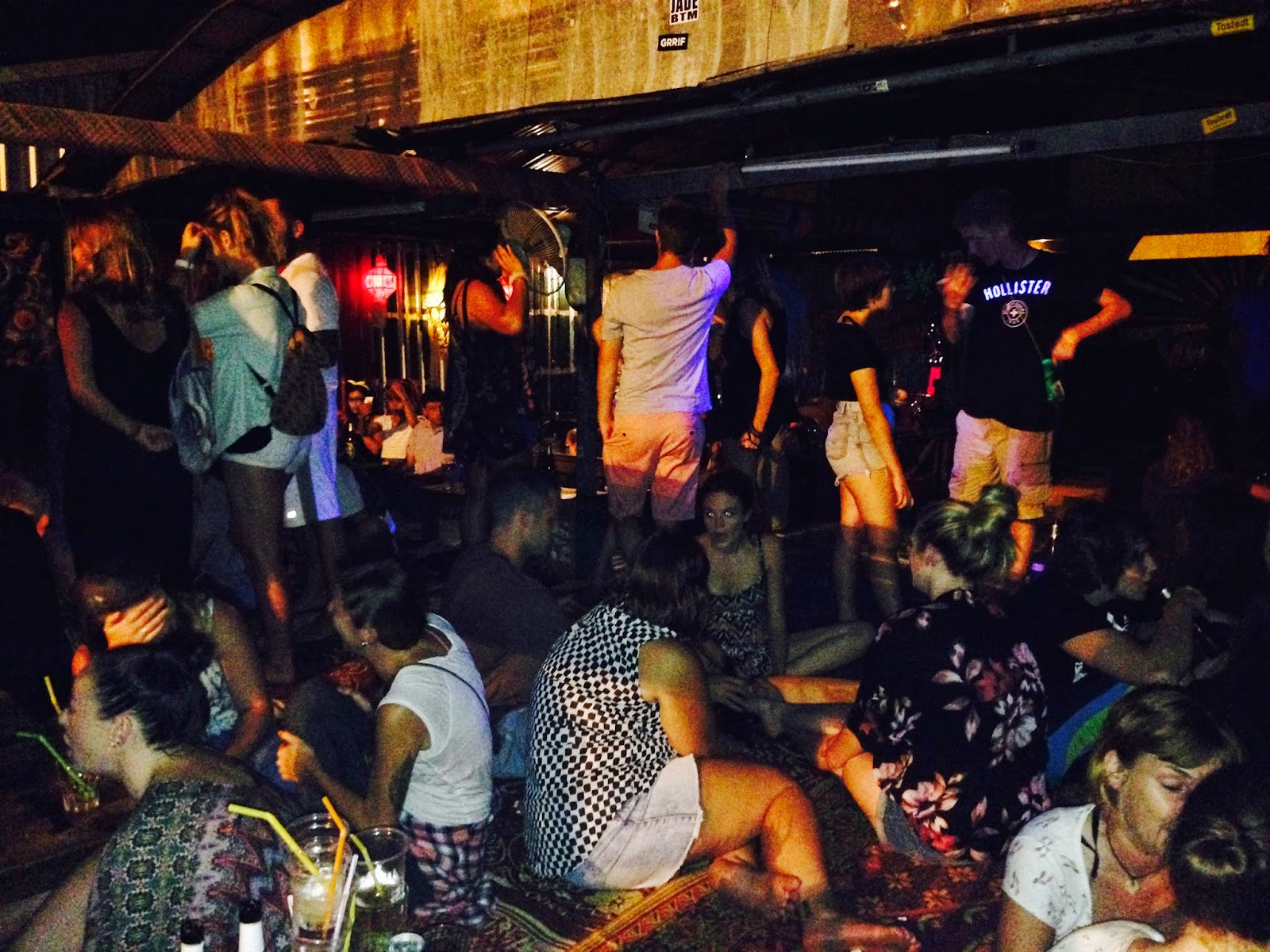
It's sort of an unspoken rule that water fighting is limited between about 9am until dark o'clock. By evening, the soggy and chilled are ready for a break and a shower, so everyone retires to their homes or the night markets. My wolf pack and I usually had a few beers at the hostel, then trekked down to the market for "street meat" in all it's colorful and fragrant variations. We were easy "farangs" to spot: just look for the group of idiots in blue headbands chanting "Street. Meat! Street. Meat!"
 
"Street meat! Street meat!"


So let me offer some tips. First of all, there’s really no avoiding getting wet during Songkran. You’re doomed to a soggy demise. Save yourself some chaffing and just live in your swimsuit for a week. 

Just have fun with it and keep smiling! Nobody likes the party pooper who gets a lap full of water and then screeches, “What the f***?!” at them. That happened. It just made her look like a-hole.
 
Form a wolf pack. Going it alone might seem like a good idea, but with a crew, you cover each other’s backs and can arrange very satisfying ambushes. Plus, it’s just a lot more fun when you can battle it out with a truck bed full of teenagers with ice water or another group armed to the teeth with water guns.

Source your water responsibly. Chiang Mai is surrounded on all sides by a moat. That moat takes a lot of abuse from the citizens. It’s said that before the festival, the old water is drained and then the moat is refilled so it’s “safe” but you can call a cigarette “menthol” and it’s still a cigarette. People swim in the moat and fill buckets with the tepid water. There’s nothing quite so bad as walking through the constant deluge of icy water and suddenly feel your back sloshed with liquid warmth. For a second, it’s nice, but then you realize with a shudder: moat water. There’s enough clean water flying around that it’s immediately rinsed off you, but do NOT swallow it if you can help it. And invest in the goggles or sunglasses sold on the street. Nobody likes pink eye.
While we’re talking about investments, get yourself a good waterproof case for your phone, money, keys and whatnot. Forget about taking pictures during the fight unless you have a fancy waterproof phone case. Just throw what you need into the pouch, sling it over your neck and start taking mental pictures!

My last bit of advice is don’t throw water on people who are going fast on bikes or scooters. This one comes with a fun little story: On the third day of Songkran, my fellow guests and I…(you just sang that, didn’t you?) were standing outside of the hostel armed with buckets and a big trashcan of water. We were waiting for people to come by and then whipping cascades of water down on them as they passed. For the record, it was in good fun and most people were enjoying the cool water. 

How did they know where I'm going?!?!
At one point, I was on the opposite side of the road with another girl. I was telling her about my walk-about earlier in the day and some of the wats I saw when we heard a girl scream, tires screech and a metallic crunch.

We looked back down the road in time to see a foreign girl fall in slow motion from her moped. One of the hostel guests shouted for someone to call an ambulance. Another guy started checking her out and urging the still conscious girl to not get up in case she had a spinal injury. 

At first, I didn’t know what to do. I felt a little sick, and dizzy. Just a second ago, things were fine. Suddenly, the air was too hot and the arm in which I held my bucket felt too heavy. I put it down and did the only thing I could think to do and that was to stay up the road and try to get people in tuc tucs and on bikes and scooters to detour around the crash. 

The ambulance and police came quickly and I heard the story: As the girl was driving by, she swerved away from the group so she wouldn’t get wet. It’s a natural response when you’re on foot and trying to avoid danger. It’s the worst thing to do on an unfamiliar vehicle and you swerve suddenly into the wrong traffic lane. The driver of the car fortunately saw her and stopped, lessening the damage done. 

My wolf pack and I gathered to discuss the shock and confusion we were dealing with. One guy told us that when he went to a company to rent his bike, they didn’t ask for a license or any proof he’d ridden before. They just handed him the keys. As we stood there talking, out of nowhere a Thai man approached our group and waved a furious finger at me…I’m not making that up, he was staring at me and waving his finger like Babu Bat on “Seinfeld.” He said something and I had to ask him to repeat it because I couldn’t understand his accent. 

“You should feel guilty!” he bellowed. The girls and I gaped open mouthed. I didn’t know what to do. I was pissed that he blamed any of us when the girl on the scooter swerved, and I was more pissed because I knew I hadn’t even thrown the water at her. He marched up the street and I suddenly wanted to slap him, but the air had soured and the joy had gone from the day. So we all just went back into the garden and ordered a few beers.
 
So moral of the story: Don’t throw water on fast moving vehicles. In slower traffic like around the north gate where most of the action takes place, it’s fine because the risk of crashing is minimal. 

The sad thing is, while this girl was fortunate enough to live (at least we all hope she did; if Thailand is anything like Japan, they guard personal information like Dick Cheney guards his gun collection),
many people are not so lucky. In Chiang Mai alone, we heard that about 60 people died during Songkran, mostly from traffic related accidents. The previous year, someone got drunk and drowned in the moat. So yes, it comes with risk, but so does running with the bulls and Independence Day. Celebrate responsibly!

If you are lucky enough to survive Songkran, celebrate as I did: with milkshakes at Pinky Milk cafe and a full-body massage by an ex-con!

Sunday, April 19, 2015

Where in the World is Marta Senn-Diego? The Thirteenth: What's in a Day?

So I was at the amazing Elephant Nature Park. I've already said a few times that we definitely didn't ride the elephants and there are no performances where the elephants paint those, admittedly, ele-fantastic paintings (gods, I can't help myself). So, what did we do?

I'll tell you what we did.

As a weekly volunteer, you pay a lump sum for room and board and then work your butt off from Monday morning until Sunday morning. We got to relax that first Sunday and just enjoy the beautiful park and the delicious food as well as a massage if we were so inclined. Yes, there were actual women at the park every night to give Thai body, foot, or head/neck massages! The dining platform had a second floor which was converted to a massage parlour so in the evening, freshly showered, you could enjoy a good massage for a pittance! Those tiny women twisted me into a pretzel and beat me into a blissful submission a few times.

There's even a souvenir shop for the daily visitors and a snack bar completely with fresh coconuts, wine coolers and enormous Singh and Chang beers for especially long days.

But to earn your Chang, you work for the changs...er, elephants. About 70 volunteers work each week, divided into groups. Incidentally, one whole group that week was a class of high schoolers from northern Virginia! Talk about the best school trip ever! France? England? What's that compared to an eco trip to volunteer at an elephant sanctuary?!

Anyway, the groups are divided up and then every day you're assigned a morning job and an afternoon job. They are as follows:

Ele-kitchen: Unloading trucks of pumpkins or watermelons were the two tasks this week, but it could also be making rice balls of bananas and tamarind paste, dicing the melons and 'kins, or whatever else you were asked. For us, it was forming bucket-brigade teams and tossing the suckers and stacking them on shelves.

             Pros: GREAT workout! And sometimes, a wandering ele (pronounced "Eh-lee") would come by   
                      and steal a pumpkin snack just feet away from you!

             Cons: getting hit in the ribs, hip, or tit with a watermelon. But then it drops, cracks open and you
                       have a snack yourself, so really, maybe this is a Pro.

Cleaning the Park: Grab a shovel or rake, you're taking a stroll around the park to clean up the poop and discarded cornstalks. It's not so bad: you develop a "sandwich" system where you rake everything into small piles, then one person gets everything onto a shovel and someone else presses a rake on top and together you lift the pile onto the truck bed.

             Pros: When you're on the grounds, so are the elephants and the mahouts. Curious eles might stroll
                      over and inspect the job you've done and generous mahouts might give you some bananas or
                      tamarind to feed the eles. Great for a photo op!

             Cons: It's pretty tedious, but when everyone works together, it's a quick job and you usually finish
                       quickly and can go walk dogs or toss melons.

Cutting Banana Trees: Banana tree trunks are mostly water, so they're like ele-cele-ry...elery...They're a good snack. So everyone loads up in a truck bed and you're whisked down the twisty road to where banana trees are growing wild. No stubby little bananas to be seen, but they're free trees.

              Pros: It's Arm Day, everyone! Lifting those trunks is an amazing workout for your back and arms.
                       And after, you can stop at a roadside shop and get ice cream and totally cancel out all that
                       exercise. Yay!

              Cons: You don't actually get a machete. No, the 13 year old Thai girl and her mother and aunts get
                        the blades and set to work hacking the living hell out of trees.

Corn Cutting: Easily one of the hardest jobs at the park. You're loaded into a bigger truck bed and your truck along with a truck of men drive 45 minutes out of the jungle to a farm. The ENP has a deal with a farmer who lets you cut the corn you need. The team spends all day there, bagging some ears of corn, cutting stalks and making dozens of piles of 25 stalks. At 11:30, everyone gets a much needed break for a picnic lunch of rice, pad thai, crackers, sliced vegetables, bananas, and a giant omelet. Then, in the afternoon, the corn and stalks are stacked in the trucks. It takes about 2 or 3 hours with frequent breaks, but then you drive home on your mountain of corn stalks like the victorious corn-conqueror that you are!

                Pros: The egg omelet. And the cookies. This is also the day you get to wield a weapon. They gave
                         us the sharpest scythes! Highlight of my day may have been watching one of the Thai men   
                         sit down, pull a watermelon out of who knows where and use a scythe to just slice through 
                         it like nothing then have himself a tasty treat.

               Cons: It's exhausting work. Bending, cutting, carrying...it's hard and it's hot. It's worse when 
                         some people don't do their fair share! But in the end, it's amazing to see the acres you've
                         cleared. If you get back on time, the VC even takes you tubing on the river!

Marta's Misadventure on the River: We started at a drop off. Thanks, Toby. I was the first one in. I sat down on my tube and pushed off. Right off the bat, I spilled out and went under. My tube started shooting down river and I had to scramble to get back on it. Looking back, my whole loving group was laughing. But I took it in stride and felt greatly refreshed!

Finally...

Ele-Poo: Closed toed shoes, check. Sunscreen, check. Shovel, check. Let's scoop some poop!
                  
               Pros: Elephant diets are high fiber, so their poo is like giant rabbit droppings: round and compact.
                        And if it's been in the sun, it's dry and doesn't smell at all.

               Cons: The fresh stuff or anything that's been sitting in the shade smells, well, fresh. There's a
                          reason they tell you to wear closed toed shoes, too: the fresh stuff isn't so easy to shovel 
                          and it tends to...drip.

But at the end of the day, you got great exercise, everything you did was for the good of the elephants, and if you were lucky, a grateful ele came by to say "thanks."

Where in the World is Marta Senn-Diego? Part Twelve: Lek...Small but Large


“Lek" Chailert. Her nickname means "small" and indeed she is a petite Thai woman who started the Elephant Nature Park with just a few acres and a handful of hurt and soul-damaged elephants. Now, she has a beautiful and natural working center. Everything is wood and bamboo and woven thatch. The food is cooked daily and in Thai style with plenty of rice, curry and fruit. 

Dogs and cats have the run of the place and gladly follow people around for a cuddle or a scrap of the delicious food. The dining platform extends into a sky walk along the riverbank so you can enjoy a breeze and the trumpet and squeals of elephants. When you shower, you can look out the window and watch an elephant munch its dinner.


The first evening before dinner, we watched a video about how wild elephant calves are taken from the jungle, strapped in a wooden cage called a "crush" and brutally beaten and stabbed to break their spirit and "tame" them for human use. Phajaan is hard to watch but without it, young wild elephants grow up and invade farms for bananas, sugar cane, melons and the like because the farms have replaced their natural foraging grounds. When they do, farmers have the "right" to shoot, beat, blind and even kill the elephant. 

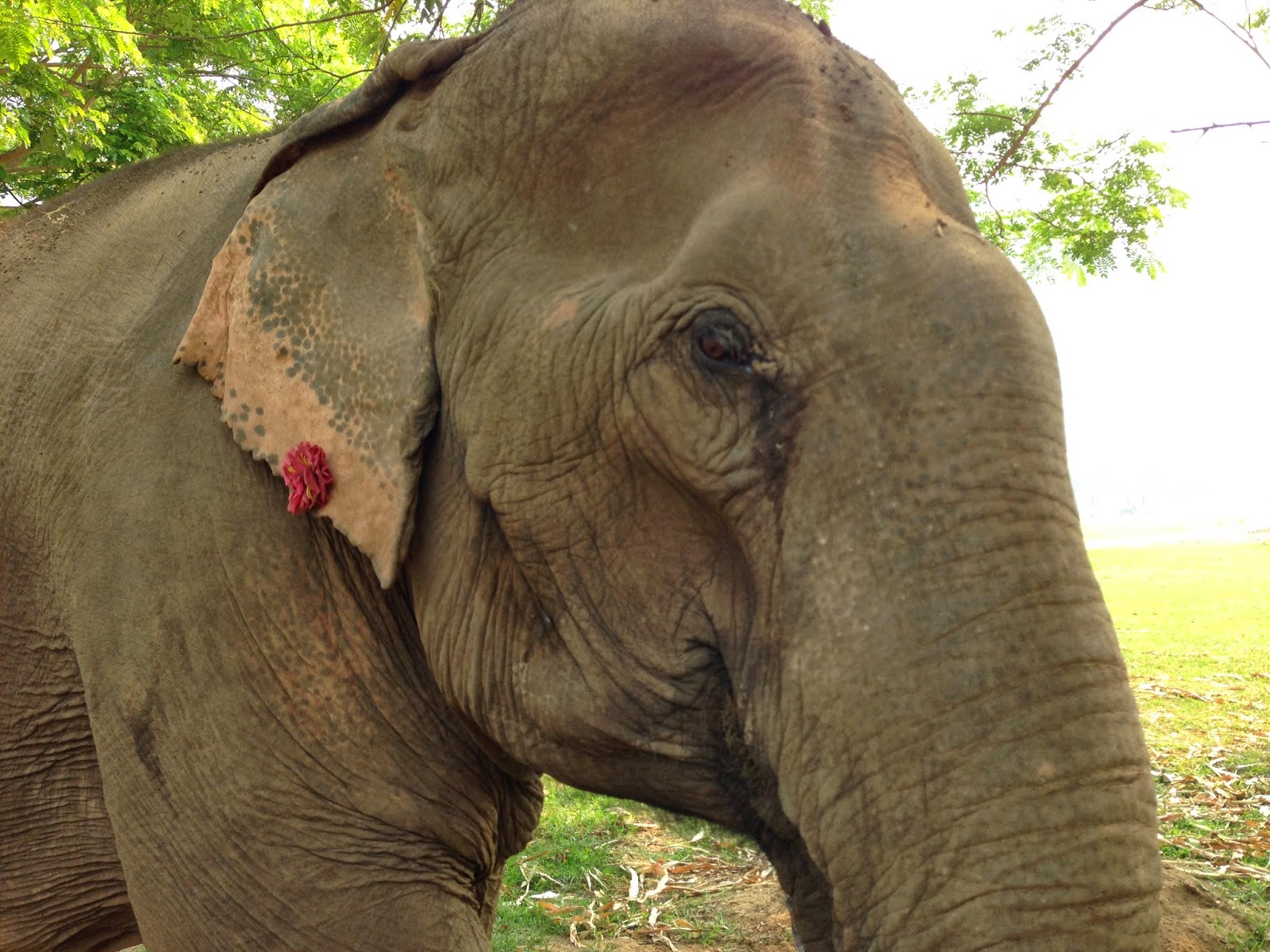
The first evening, we also received a "good luck" blessing
It's a vicious cycle if ever there was one. We also met Jodie, a former weekly volunteer who now lives in a small house on the park's property. Jodie gave us the safety run-down and very pointedly told us the purpose of the park was not to ride or swim with the elephants like other parks boast, but to make their lives more comfortable. After the years of trauma they've suffered, it's the least we could do as volunteers. 

We even met some of the elephants and volunteer coordinators. Prom introduced us to a young bull who had been discovered trapped by the foot in a tiger snare. The reduced circulation caused an infection and for months, his foot has been wrapped into a large club-shaped bandage which he scratches with his tiny tusks. We said hello to Full Moon whose former mahout worked with her for her whole life (over 60 years) but eventually couldn't take care of her anymore and chose to give her to the park. She has a new mahout, but was heartbroken when her old one stopped coming to visit her. Every time he said goodbye was painful and he just couldn't keep doing it. 


Jokia hasn't been so lucky. When she was younger, she was sold into the logging industry. She was pregnant at the time and on her first day of logging, the effort of the heaving the log up the hill caused her to miscarry. She immediately lay down in grief and to get her back up and working again, she was shot in the eye with a slingshot and blinded. When she couldn't log anymore, she was sold to a trekking group. When she tried to protest that, too, she was stabbed in the other eye. Now she's completely blind. When Lek found her and bought her, Jokia had nothing but her sense of smell, touch, hearing and her fear.

But compassion won out when another female at the park reached out and became Jokia's constant companion. Today, the two elephants are never without each other. 

After all that information, we received a rare treat: as we listened to Jodie talk, a small family of elephants passed under where we sat on the sky walk on their way to the river for a bath. The only thing between our butts and the elephants' was about seven inches of wood planks and air! 
Naughty Navaan says "Hi!"

Our contact between the elephants was limited to whenever we were out on the grounds under supervision maybe scooping poo and only if the elephants felt like checking us out. The priority wasn't going to be touching or riding the elephants. 

Unfortunately, that plan didn't hold up so well with some of the guests. Apparently, a few people used a travel agency in the UK that seemingly led them astray and told them ENP was a park where they'd have close, personal contact with individual elephants and get to ride them. 

The view's better when you're not on their backs
But even after all the talks and videos, they were still miffed that there wouldn't be any riding! One couple even had the audacity to say "We wanted to end our trip on a high note." Maybe they misspoke. But I'm inclined to think they just didn't get it. Eventually, they gave up saying they'd leave after just two or three days. They still left early, but not as early as some others. For some odd reason, most of the complainers were in my group. I tried to keep putting a positive spin on things to keep other groups from thinking I was a "Twitter" too (I developed that nickname because this group was also obsessed with the WiFi and having Internet and constantly whined about not having better service in the middle of a freaking jungle).

So for example, when a Twitter said, "It's so hot! I can't keep carrying these banana trees," I'd say, "But think how good a cold shower will feel!" When one said "Tossing melons is too hard!" I'd reply, "Think of it as a medicine ball at the gym: who needs zumba to get ripped?"

Sure, it probably made me look like Susie Sunshine, but it was better than just whining like the rest of them. Of course, the kvetching bugged the volunteer coordinators, even though they kept their annoyance well hidden...most of the time. One of our jobs on the second day was cleaning the grounds by shoveling and raking poo and uneaten corn stalks into truck beds for composting. When we finished early, we walked from the river to the "elephant kitchen" where another group was tossing pumpkins. Our VC, Toby, told us we'd take the shovels back to the tool shed then could go walk dogs or help in the kitchen, one Twitter squealed, "We have to walk there? Last time we rode in the truck!" 

Toby looked at me, then looked at her, incredulous. "Huh?" he asked, incredulous. 

"The truck has poo in it," I said. And besides, the tool shed was just up the road and we'd walk through a garden to get there. It was literally a 2 minute walk. Either the heat had gotten to her or she was just a spoiled child. Her parents were sponsoring her gap year so I started to think the latter. She was also the same girl who, on corn cutting day, spent half of the day sitting in the shade while the rest of us carried 100 bundles of corn stalks and 50 bags of corn from the field to the truck. The mahouts had to pick up the slack and put us all to shame by carrying 4 or 5 bundles at a time while we each struggled with one at a time.
Seeds of hope...or pumpkin. Sometimes, it's hard to tell under all the poo.
Lek, the VC’s, the mahouts, and the people who just work on the park’s property make very little money and work every day in heat and sun and rain without complaint. I couldn’t believe anyone would have the set to complain within earshot of any of them. Fortunately, Lek was away on elephant business. It would have been so embarrassing to be around her knowing she’d hear about the people in my group. I did what I could to set myself aside from all that negativity and asked Jodie how I could keep helping the park remotely until I saved up enough money to return to Thailand. She told me about the Elephant Ambassador program and encouraged me to apply. More on that as it develops!

Where in the World is Marta Senn-Diego? Part 11: Elephant Nature Park

Elephants. They are beautiful, old, instinctive, and magnificent animals. In Thailand, the Asian elephant has been highly regarded in both religious and social aspects. They carried kings into battle, were painted for holy holidays, and were as common for transportation as horses have been in the West. One of their gods, Lord Ganesha, is an elephant-headed deity.

And yet, despite all the reverence, elephants have been horribly and sickeningly abused-- not only in Thailand, but around the world. One (formerly) common use for elephants was in the logging industry, helping to clear their own natural habitats, rainforests. They dragged enormous logs by chains attached to their legs. Elephants are strong, absurdly strong, but even non-stop, back breaking manual labor like that is often too much for some to bear. Eventually, the Thai people realized the rainforests were a necessity and banned logging in the country. Burma, however, wasn't so quick to follow suit and today, elephants are still logging.

Another offense is also a very controversial subject: elephant riding and trekking. Here's the thing: as I said, elephants are amazingly strong animals. They can carry an adult human easily. They might as well have a mosquito on their shoulders. But the second that mosquito puts an uncomfortable metal frame on their back and forces the elephant to wear it and load after load of noisy, squirming people for eight hours or more a day...it becomes a different story. "Camps" and "parks" where the main attraction is riding an elephant often may mean that elephant has been working in the scorching Thai sun for hours.

The wild elephants of Thailand used to be in the hundreds of thousands. Now they are a miniscule fraction of that. Many more elephants are domesticated and working in tourism, either trekking or painting, in circuses and even begging on the street. In these cases, young elephants live with their mahouts under bridges or on the outskirts of a city and in the evening, journey into the city streets to draw crowds of tourists. The mahout sells bananas to the tourists who then pay for the chance to feed and pet the baby elephant. The problem is the animals are usually underfed and over stressed because the sensitive pads of their feet, which they use to feel seismic vibrations in the ground are overstimulated by the traffic and noise of the city.

One of the biggest problems in Thailand is the discrepancy over whether or not elephants should be domesticated. When they are, they're considered "legal" and unabused in trekking camps because they're in the same category as livestock like horses and cattle.

So with such a diminished population, you might think the best course is a breeding program. Heartbreakingly, forced breeding is often painful and dangerous. I saw the effect of not only forced breeding but also logging, poorly conducted tourism operations, landmines, and just plain cruelty at the Elephant Nature Park.
Many elephants suffer broken or dislocated hips from forced breeding

ENP is located over an hour north of Chiang Mai, Thailand. To get there, you have to drive out of the city and into the beautiful northern Thailand jungle. The road twists and bends and climbs deeper and deeper into rainforest. As you near the somewhat misnamed park, you spy the sanctified orange sashes tied around trees here and there along the road. In an effort to protect the jungle from deforestation, ENP's founder, Lek, participates in the practice by having sashes blessed and they tying them around the trees. The trees are then considered holy and cutting them would be sacrilege.

The park is in a remote valley by a river. Small villages surround the valley and elephant trekking companies are nearby. It's strange. While we rode the ENP's shuttle van past these parks, we watched an introductory video on ENP and Lek's no-chains, no force, no riding methods. Then we'd look out the windows at elephants bearing metal saddles or chained in stalls.

Lek started the park in the early 2000s with just a small patch of land and about five abused elephants she bought one by one from their mahouts. First, Lek is not wealthy. She is the granddaughter of a town healer, with a holistic and loving view of elephants. She lives at the park in any spare bed because she doesn't have a house. The park was built on her blood, sweat and a lot of tears. She wholeheartedly believes that elephants deserve all the love and respect we as humans can give them.

The park has grown and now there are over 30 elephants including a few calves who were born at the park and never "broken." While they're cute, this also makes them more dangerous, but also great successes in the park's mission.

Visitors can stay at the park in a variety of ways: for just a day visit to feed, photograph and learn about the elephants; overnight for more of the same; a week to two weeks to work and help the elephants and also the hundreds of dogs on the property; and sometimes longer.

I opted to stay for a week. And I left, knowing I'd be back. The work was tiring, but (and I know this is going to sound cliche) amazingly rewarding. Everything that you're asked to do is in direct relation to the elephants whether you're helping cut corn, tossing watermelons, making tamarind and rice balls (yes, elephants love onigiri!), carrying tasty banana trees, or the most lovely job of all, scooping poop, is for the benefit of the elephants. I'll go into more detail about the week later. I just want to conclude here with the link to Lek's program and this simple request:

Look into it. I went to Elephant Nature Park thinking I'd have a good time and get to see some elephants. I didn't realize my eyes would open to a world of pain, love, desperation and Hope.

www.elephantnaturepark.org

Saturday, April 4, 2015

Where in the World is Marta Senn-Diego? Part Ten: Wat's Up, Doc?


Saturday morning, and I awoke not knowing where I was. I had to remind myself that I was in Bangkok. Bangkok! And I had a lot to do in the next 12 hours: explore some temples, or “wats,” buy a new phone (Japanese provider, Au, doesn’t unlock phones for international use. Bullcrap!), and order a tailor made dress for my cousin’s wedding in June. 

When I arrived in Thailand the previous day, it was only mid afternoon and 33 degrees Celsius, so I wanted to get out early and start walking while the weather was cool. I was on my way down the sidewalk when a tutut driver asked where I was going. I pointed on the map to Wat Po and the royal palace. 

“No,” he said. “Now they’re having prayers and ceremonies. You should go in the afternoon.”

Then he took a pen and my map and showed me what I should see instead in the northern part of town including the temple of the great standing Buddha, the lucky Buddha for my traveling, Wat Saket, also known as the Golden Mountain, and the Thai Factory for my dress order.

Before I could ask for the best route, he went on to tell me that if I took a tuttut, the driver would take me to all these places…for free! Certain tuttut taxis are government-sponsored, so during tourist season, they get a coupon for free gas for showing yokels like me the beautiful city! I couldn’t believe my good luck! He got a tuttut for me and together, the driver and I spent the next few hours stopping at every place marked on my map. 


I saw gold foil-flecked Buddhas, Bangkok from above at Wat Saket, people cooking as well as fixing cars in the streets (not just changing tires: dismantling engines and realigning bumpers), and absolutely stunning architecture.

Pei, the man who gave me all that valuable advice, also told me that if I wanted to go to Chiang Mai, because many people will go to their provinces for Songkran New Year Festival, I needed to book a train or bus today! I didn’t realize! So we stopped at a travel agent’s office.

The buses were all fully booked, but I was lucky enough to get the last train ticket leaving on Sunday. Unfortunately, it leaves in the evening, so I had to cancel my hostel in Chiang Mai and let the Elephant Nature Park know I’d arrive at their office around 8:15 am to pay the balance and drive north to the park with them. I’ve been a pain in their ass, I’m sure, but I hope they understand the issues with transportation. 

High season and all that.

I had to sacrifice a large chunk of Baht for that ticket, but these things can’t be avoided. Another small wad
went into something much more fun: two tailored, custom dresses! The Thai Factory tailor sews
original suits and clothes for women. This business is all over Thailand, but the Factory was recommended to
be by Pei, so I went for it.

 I was looking a haggard mess, but they treated me like royalty and the clerk was very helpful
in choosing a pattern and color for my cousin’s wedding. And for the price, we decided could afford a
second dress made of Thai silk! On Sunday, I’ll go back for the fitting, but then they’ll make the dresses and
mail them free to America! 

View from the Golden Mountain
After all that, I had to go into the heart of Bangkok. I needed to visit the more urban, high-tech center for a new iPhone. But it was too far for the tuttut, so what’s a girl to do? Take a river taxi, of course! Jump into a long, low, motorized boat and off you go up one of the several rivers through the city! Before you know it, you’re in the throbbing heart of the city at the base of the greatest shopping malls in Bangkok, especially for phones. A much larger chunk of cash out the window, but this phone can accept international SIM cards, so boo on you, Au! 

I had a delicious lunch to cure my hunger pains: stir fried rice with shrimp and salmon in a baked pineapple and another coconut water. For 300 Baht. $1 = 33 Baht. Yeah. 

Another river taxi delivered me to the western part of town again. I spent some time stretching my legs and walking to Wat Phra Kaew, famed for its graceful golden spires, and Wat Po to see the giant reclining Buddha!
 
Sated on wats for the day, I hit the street again. I passed a tuttut driver asking two girls where they were going. They happened to be going my way, Khaosan Road. He offered them 150 Baht. They turned him down flat. He then turned to me and asked where I was going. I told him Khaosan and he gave me the same fare charge. Feeling gutsy, I hemmed and asked for 100. He balked and said 150. 

“Okay, sorry,” I said. “I’ll just walk.”

He immediately submitted and for 100 Baht, I saved myself enough money to get a papaya juice and pad thai dinner. 

Check “learn to haggle” off my bucket list!