I'm going on an adventure!
Well, a new one anyway, and much more grand in comparison than the day trips I take on occasion to the coast or down to Sendai.
No, no. I'm stepping out into the wide world completely solo. As a teacher for Interac, I had a company to rely on. It was like taking a trip with a ginormous, corporate parent who could handle all the messy bureau-crazy and remind me to file a form or eight every now and then. They found housing for me and set up my schedule so all I had to do was show up for work and plan my own free time.
But now that I'm leaving Japan, I have a great opportunity to try and do all that messy business for myself. I anticipate falling flat on my face quite a bit, but oh, what a wonder the Internet is and all it's helpful users and their guiding hands! Every day, I do a little research on another aspect of solo travel: interesting things to do, how to pack light, where to get the best cup of coffee, how to successfully evade assault...the vital things.
Oh, what's that? Where am I going? Funny you should ask. I'm still ironing out the little creases, but the general plan goes like this:
Late March: Southern Japan including Hiroshima, Fukuoka, and Sasebo to do some more hard-hitting research about my grandmother.
First 2 weeks of April: A couple days in Bangkok, 1 week in the north working at an elephant reservation, 1 week in Chiang Mai enjoying the wats (temples) and Songkran (New Year's/World's Biggest Water Fight)
Mid-April: A few days in Paris and some outer edge cities
Last week of April and First week of May: Amsterdam!!!
Details to follow!
Wednesday, February 11, 2015

Tuesday, February 3, 2015
Out With Devils
Out with devils, In with fortune! Happy Setsubun! On the old lunar calendar, today is the official first day of spring.
You could have fooled me: these past couple of days have been crazy cold. Parts of Japan have seen ridiculous amounts of snow. Kitakami was hit hard last weekend, but most of that snow has since settled or melted again.
Good thing, too, because last weekend was Kitakami's yuki matsuri, or snow festival. The snow was slushy and heavy, so most people stayed inside the Sakurano Department store, but we clever and adventurous few ventured outside for two reasons:
1. Taiko and Onikenbai demonstrations
2. Tuna Butchering Demonstration
 I caught some of the taiko performance. A local group of men were beating away at drums big and small, shouting and jumping in time to the music. I adore the sound of a taiko group: it is just quintessential Japanese! You instantly imagine old war lords, samurai, katana, banners, long wooden ships diving through the sea.

Across the street in the Sakurano parking lot, there were a few food stands set up selling minestrone soup, croquettes, and mochi. At the far end of the lot, a small sledding hill was full of children and neon toboggans which of course was why I was there.
No, not really. My main objective was the Tuna Butchering Demonstration!
In a large wooden crate filled with ice, a very large tuna gazed up at the sky. It had given its life and I wonder if it ever imagined it would be sitting in a snowy parking lot, waiting to be broken down into small, immaculate little cubes. I wonder if it ever thought it would leave the sea. I wonder if it thought.
 Anyway, zen Senn is done. Back to the carnage.
There was a team of three men behind three tables under an awning. The first man made a big show of picking up the enormous fish and showing us the girth and announcing proudly how much it weighed and were it was caught.
He then carefully laid the fish on his table and brought out his knife. In a smooth and quick motion, he sliced right behind the gill. He flipped the leviathan over and then made another slice. Et voila! Fish head is removed and set on display!

While he continued to slice along one side, the fish's head stood watch over its own butchery.
With one large, fat filet removed, the second man stepped in. He took the tuna onto his station and began to clean off the skin and cut the meat into long rectangles. After cleaning and thinning out a few portions, he had about seven long slabs in a bin.
 The bin was passed to the third man just as another filet was set before the second man. The third man's job was the most exacting: the slice perfectly even and matching pieces of the freshest sashimi you've ever seen. I was amazed at how fast and focused these men were!
 And the tuna! The taste! The smell! It was incredible! People in the crowd gathered around another table, grabbed wooden chopsticks and dove into the sample plates. It was a small group so you could go back and get a few plates if you wanted. I had three and then I was starting to feel guilty for indulging so much, so I went back to the first table.

 The first butcher was actually scraping tuna from the fish's ribs, ever little ounce, and piling it like tartare on plates. Here, children were just diving into the communal plates with their waribashi, just going to town. And I went right along with them.
Put that on the top of my list of things I'll miss about Japan: fish butchery demos.

You could have fooled me: these past couple of days have been crazy cold. Parts of Japan have seen ridiculous amounts of snow. Kitakami was hit hard last weekend, but most of that snow has since settled or melted again.
Good thing, too, because last weekend was Kitakami's yuki matsuri, or snow festival. The snow was slushy and heavy, so most people stayed inside the Sakurano Department store, but we clever and adventurous few ventured outside for two reasons:
1. Taiko and Onikenbai demonstrations
2. Tuna Butchering Demonstration
Across the street in the Sakurano parking lot, there were a few food stands set up selling minestrone soup, croquettes, and mochi. At the far end of the lot, a small sledding hill was full of children and neon toboggans which of course was why I was there.
No, not really. My main objective was the Tuna Butchering Demonstration!
In a large wooden crate filled with ice, a very large tuna gazed up at the sky. It had given its life and I wonder if it ever imagined it would be sitting in a snowy parking lot, waiting to be broken down into small, immaculate little cubes. I wonder if it ever thought it would leave the sea. I wonder if it thought.
There was a team of three men behind three tables under an awning. The first man made a big show of picking up the enormous fish and showing us the girth and announcing proudly how much it weighed and were it was caught.
He then carefully laid the fish on his table and brought out his knife. In a smooth and quick motion, he sliced right behind the gill. He flipped the leviathan over and then made another slice. Et voila! Fish head is removed and set on display!
While he continued to slice along one side, the fish's head stood watch over its own butchery.
With one large, fat filet removed, the second man stepped in. He took the tuna onto his station and began to clean off the skin and cut the meat into long rectangles. After cleaning and thinning out a few portions, he had about seven long slabs in a bin.
Put that on the top of my list of things I'll miss about Japan: fish butchery demos.
Thursday, January 22, 2015
A Thought
It's so crazy to think that I'm leaving (relatively) safe Japan for America in a few months.
I'm scared. That's only a half joke. I was anxious coming to Japan because I was coming alone, I was going to start from the ground up, pay bills, live alone, and generally be an adult for the first time in an unfamiliar country with unfamiliar people and an unfamiliar culture. It's true Japan is safer than America: America's effing dangerous!
The first day I was at my favorite school, the students had their first bi-annual emergency drill. While we were all convened on the hard-packed dirt yard, "Auntie" sensei asked me about my religion. This was only our second conversation. The first had been the day I came to meet the principal and other English teacher. That first conversation was generally, "Nice to meet you, I'm looking forward to meeting you, excuse me, I have a class now."
This second conversation, she looked at me and asked if I was Christian. Over the past couple of years, our relationship has been based on this candid sort of approach. Simply by default, we can talk about things like this. We've had pretty significant talks about religion and American policy, which is saying something given how naturally diplomatic the Japanese are.
I mean, public toilets come equipped with the sound of a waterfall to cover the sound of your business. This is a POLITE country.
So given our conversational history, it wasn't shocking at all to me today when Auntie asked me about gun-policy in America. She wanted to know why America has so many more gun accidents than Japan, because we're not naive: we know there's gun violence anywhere there are guns. Duh. Just in Japan, it's miniscule compared to the absolute cluster America has become in recent years.
The simplest way I could explain it to her was by summarizing the "right to bear arms" part of the Constitution. But, I told her, that was written in a time when America was defending itself against external control by an old country that the new citizens of America had left because THEY. DIDN'T. WANT. TO. BE. CONTROLLED. ANYMORE.
We agreed that America has, over it's 200 + years become adapted to the "we are right, you are wrong" way of thinking. I also told her that this idea of America being the best has been warped considerably to the point that Americans are blind to its flaws. At one point, yes, America was a powerhouse. But we've slipped since then, and a large number of very loud people refuse to admit that.
America has a lot going for it. We have a diverse culture. We have a beautiful nation. We have food and drug policies. We have democracy and freedom of religion. But we also have violence, drugs, corruption, and numerous health problems battling with an crippled healthcare system. We're not terrible, but we're not the greatest.
We came to the conclusion, she and I, that to make a country better, it's people have to be humble of their country's misgivings, but also proud of their country's achievements and benefits; respectful of tradition, and brave enough to change.
Anyway, that's my two yen for today.
Saturday, January 17, 2015
When Pigs Fly
The sad news is that I'm leaving Japan in a couple months. After two years of being a registered citizen, I'm migrating back to my roost in America. I don't know what to expect back there, but I'll be happy with whatever is thrown at me.
I was expecting my world to shrivel and sort of implode since I started telling people I'm leaving. But instead, my world has simply continued to expand! People aren't slinking away from me as if I'd farted in church. On the contrary, I'm gathering more and more phone numbers and emails and addresses so I can keep in touch with old stand-bys and new friends. With the new friends, we both lament that we've connected so late into my time here, but the beauty of living in such a connected world thanks to Facebook and Skype and the glorious thing known as the postal service, we'll still stay involved in each others' lives.
My parents still write Christmas cards to old friends from college and their youthful travel days. I'll actually be meeting one of my dad's friends when I go to Amsterdam in April. I remember being a kid, dutifully decorating our Christmas cards and envelopes and asking my parents about the cards that were leaving the country. I'd see a foreign address and ask my parents about the recipient. I loved hearing the stories and thinking that this card in my hand was going to an exotic, distant land like Puerto Rico, Amsterdam, Germany, or Canada.
I love my parents for keeping up with those friendships: it takes a special effort these days to send mail the "old" way with stamps and stationary. I want that for myself. I want that tangible evidence of our friendship flying across the world to land in someone's mailbox. It's old-fashioned, maybe bordering on obsolete, and I will lament the day sending cards and letters is no longer possible because I'm a pessimist about things like this and I can absolutely see that happening.
Until then, I'm glad to cling to my address book and watch the pages fill with names and street numbers.
Wednesday, January 7, 2015
Kimono for Beginners
Hallelujah! I finally got to wear a proper kimono! Another of my lifelong dreams has come true and I was literally wrapped in yet another beautiful and intricate part of "true" and "deep" Japan. My friend, Harue, invited me to her town to try on one of her mother-in-law's kimono. Every new year, Harue and her daughter wear a kimono and have their picture taken. This time, I got to join them!
When you think of traditional Japanese clothing, what comes to mind? Long flowing robes and wide sashes tied in complicated knots, probably. Or you imagine men wearing wide-legged pants and boxy shirts with square sleeves, tied with a sash. And of course, there are the white toe socks with only one toe. But do you know the names of each item? Do you know how to wear that beautiful red-carpet worthy robe? Do you know how to tie that enormous sash?
Welcome to Kimono 101!
 First let's lay the basics out. I don't know men's clothing as I'm not a man. I know, shocker! So I'll just be glancing over the basics of women's clothing. Let's start with the first distinction: kimono.
"Kiru" means "to wear" and "mono" means "thing." Interestingly enough, "mono" can also be read as "butsu" so when you add it to "dou" (move), you get "doubutsu:" literally "moving thing." We also say "animal."
So a kimono in it's broadest definition can refer to simply a thing to wear. Specifically, it refers to the commonly beautiful women's robe. However, you can't confuse it with a yukata: the cotton robe usually worn at hotels, onsen, ryokan and in public as casual wear. A kimono has many more elements and is traditionally much more formal.
Now let's begin.
Let's start from the ground up...or the inside out. The first thing I put on were the tabi: the toe socks. They come in a small variety of sizes and are meant to fit a bit snug as I understand it. They sometimes even have a little cardboard reinforcement in the soles. You slip your big toe into it's sleeve and then fasten the tabi at your ankle with little clasps.
Ancient Japan did not have bras, so bras are optional! They also didn't have panties. However, winter is also crazy cold and I cheated and kept my...ahem, layers...on under the rest of the gear which goes a little like this:
Koshimaki: the hip wrap. It's a bit like your great grandma's silk or satin slips. It's a thin wrapping skirt that ties just at the hip bones.
Hadajuban: the Japanese underwear. It looks like a very thin yukata, sometimes made of silk or satin instead of cotton or linen, so you wouldn't dash to the Daiso in one of these. That's tied with a koshihimo, a thin sash with tapered ends.
Korin: an elastic belt. This is a little more modern an element, but the elastic and the metal clips keep the hadajuban secure.
By this time, you're wondering if all this gear is necessary. I mean, you haven't even put on the kimono itself! But let me explain. The final goal is the presentation and ideally, all the undergarments conceal the body's natural shape and ensures everything lies crisp and flat. You don't wear a kimono to show an alluring figure or magnificent cleavage. The beauty is the kimono and how it's carried. That's our goal.
So suck it in because now it's getting serious!
 Obi ita: obi board. An oblong, stiff little board, the obi ita is pressed against your stomach to make sure the front of the obi is supported and will lie flat after all the tying and tightening.
Now depending on your body type, you might need some more padding. If you're like me and you have wider hips and no chest to speak of, you cheat the system with cushions, little pillows and folded material to achieve a nice straight line.
Yukata: yet another thin robe. It can also be called "juban" meaning "second layer." You tie that with a synthetic sash. Inside the collar is a stiff eri shin, or a thin piece of plastic that keeps the collar high and arched. The collar doesn't lie against your neck: instead, it sits up and away from your neck.
Kimono: the robe. Finally, you slip your arms into the wide kimono sleeves. Marvel at the beautiful color, the mesmerizing design and shimmering threads in the embroidery. Kimono are art. You are wearing art!
Obi: the belt. Obi are no joke. They are very very long and heavily brocaded sashes and they are a hassle to put on by yourself. The easiest way is to fold about a foot of one end in half and lay it over one shoulder out of the way. Then begin to wrap the obi around your chest. It should sit almost uncomfortable high: if it seems weird, just remind yourself that you need to be able to eat and if it's on your tummy, you can't stuff yourself with sushi later!

There are several types of obi knots. Some are like bows, some look like flowers or stars. I was given a butterfly.

As a final accessory, tie an obijime around the obi. It's a thick cord, sometimes with tassels, to just accent the obi and bring it all together.
 Et voila! You look great! Slip on some zori (lacquered shoes) and step out into the night. For Harue, her daughter and myself, our final destination was the Ebisu sushi restaurant to have New Year dishes, handcrafted sushi, and sake.
And of course, janken.


When you think of traditional Japanese clothing, what comes to mind? Long flowing robes and wide sashes tied in complicated knots, probably. Or you imagine men wearing wide-legged pants and boxy shirts with square sleeves, tied with a sash. And of course, there are the white toe socks with only one toe. But do you know the names of each item? Do you know how to wear that beautiful red-carpet worthy robe? Do you know how to tie that enormous sash?
Welcome to Kimono 101!
"Kiru" means "to wear" and "mono" means "thing." Interestingly enough, "mono" can also be read as "butsu" so when you add it to "dou" (move), you get "doubutsu:" literally "moving thing." We also say "animal."
So a kimono in it's broadest definition can refer to simply a thing to wear. Specifically, it refers to the commonly beautiful women's robe. However, you can't confuse it with a yukata: the cotton robe usually worn at hotels, onsen, ryokan and in public as casual wear. A kimono has many more elements and is traditionally much more formal.
Now let's begin.
Let's start from the ground up...or the inside out. The first thing I put on were the tabi: the toe socks. They come in a small variety of sizes and are meant to fit a bit snug as I understand it. They sometimes even have a little cardboard reinforcement in the soles. You slip your big toe into it's sleeve and then fasten the tabi at your ankle with little clasps.
Ancient Japan did not have bras, so bras are optional! They also didn't have panties. However, winter is also crazy cold and I cheated and kept my...ahem, layers...on under the rest of the gear which goes a little like this:
Koshimaki: the hip wrap. It's a bit like your great grandma's silk or satin slips. It's a thin wrapping skirt that ties just at the hip bones.
Hadajuban: the Japanese underwear. It looks like a very thin yukata, sometimes made of silk or satin instead of cotton or linen, so you wouldn't dash to the Daiso in one of these. That's tied with a koshihimo, a thin sash with tapered ends.
Korin: an elastic belt. This is a little more modern an element, but the elastic and the metal clips keep the hadajuban secure.
By this time, you're wondering if all this gear is necessary. I mean, you haven't even put on the kimono itself! But let me explain. The final goal is the presentation and ideally, all the undergarments conceal the body's natural shape and ensures everything lies crisp and flat. You don't wear a kimono to show an alluring figure or magnificent cleavage. The beauty is the kimono and how it's carried. That's our goal.
So suck it in because now it's getting serious!
Now depending on your body type, you might need some more padding. If you're like me and you have wider hips and no chest to speak of, you cheat the system with cushions, little pillows and folded material to achieve a nice straight line.
Yukata: yet another thin robe. It can also be called "juban" meaning "second layer." You tie that with a synthetic sash. Inside the collar is a stiff eri shin, or a thin piece of plastic that keeps the collar high and arched. The collar doesn't lie against your neck: instead, it sits up and away from your neck.
Kimono: the robe. Finally, you slip your arms into the wide kimono sleeves. Marvel at the beautiful color, the mesmerizing design and shimmering threads in the embroidery. Kimono are art. You are wearing art!
Obi: the belt. Obi are no joke. They are very very long and heavily brocaded sashes and they are a hassle to put on by yourself. The easiest way is to fold about a foot of one end in half and lay it over one shoulder out of the way. Then begin to wrap the obi around your chest. It should sit almost uncomfortable high: if it seems weird, just remind yourself that you need to be able to eat and if it's on your tummy, you can't stuff yourself with sushi later!
There are several types of obi knots. Some are like bows, some look like flowers or stars. I was given a butterfly.
As a final accessory, tie an obijime around the obi. It's a thick cord, sometimes with tassels, to just accent the obi and bring it all together.
And of course, janken.
Monday, January 5, 2015
Underhanded Secondhand
I was a dedicated secondhand shopper when I was still in America. Goodwill was pretty much my only option, but I also received plenty of hand-me-downs from neighbors, teachers and friends. I remember being very excited the first time my friend, Annina, gave me a bag of her clothes. I thought, "She's one of the best dressed girls in my class, so now I'll be just like her!" I wore one yellow shirt covered in flowers for years before I accidentally melted it with the flatiron.
Secondhand stores in Japan are big business. You can find everything from clothes to kitchen supplies to snowboards, guitars, games, consoles, cameras, bikes, couches, lamps, Hermes, Dulce and Gabbana, Louis Vuitton, Prada, and more, including those crazy things you find nowhere but Japan like takoyaki grills, sake cups, face massagers and thousands of boxed gift blankets.
I'm not kidding: every store has a whole section for these boxes of blankets that look like something from Great Aunt Bertie's nursing home. Who buys these things? Who receives them? Nobody uses them because they all end up at Second Street Recycle Store!
As fun as it is to shop in these jumble stores, it's the weirdest kind of abusive relationship. It's addictive, easy, and you get something out of it, but when you try to contribute, for some reason you get your ass handed to you. Unless you have something of legitimate value (basically platinum plated Hermes tea cups or diamond encrusted Prada heels) you're going to get screwed if you try to sell anything to them. Even Jimi Hendrix's guitar would get you a piddling 200 yen...if they have a special campaign where they're looking for rock legends' instruments.
I don't have nice things. I just don't. I don't have a need for them. But I'm leaving Japan soon and I'm trying to purge my apartment of things I know I won't be taking with me (ie winter coats, summer shoes, my standing fan, my collection of "Death Note" manga, etc.) and decided today I'd try and make a few hundred yen.
Literally, that's what I made. The "Death Note" series got me 100 yen. The rest made me about 400 yen. Yippee.
Thursday, January 1, 2015
Shimekazari Kitakami
I got to know Kitakami by walking around. It's how I found Suwajinja. It's how I mapped my jogging routes. And even now, almost two years later, I still find beautiful and fascinating new things. Now, it's shimekazari!
 Different elements mean different things. Mostly, they are symbols of prosperity and good luck.
Tai, for example, are giant carp and symbolize good fortune.


Shimekazari are all beautiful and unique. Some people make them for themselves, while most people buy them from retailers. Even at the Daiso you can get a small but functional shimekazari. But no matter what you pay, or even how you display them, they hold their own...

...even if it's just a spray of pine needles.


Businesses close for about five days at the start of the year so that family members can celebrate and be with their loved ones.


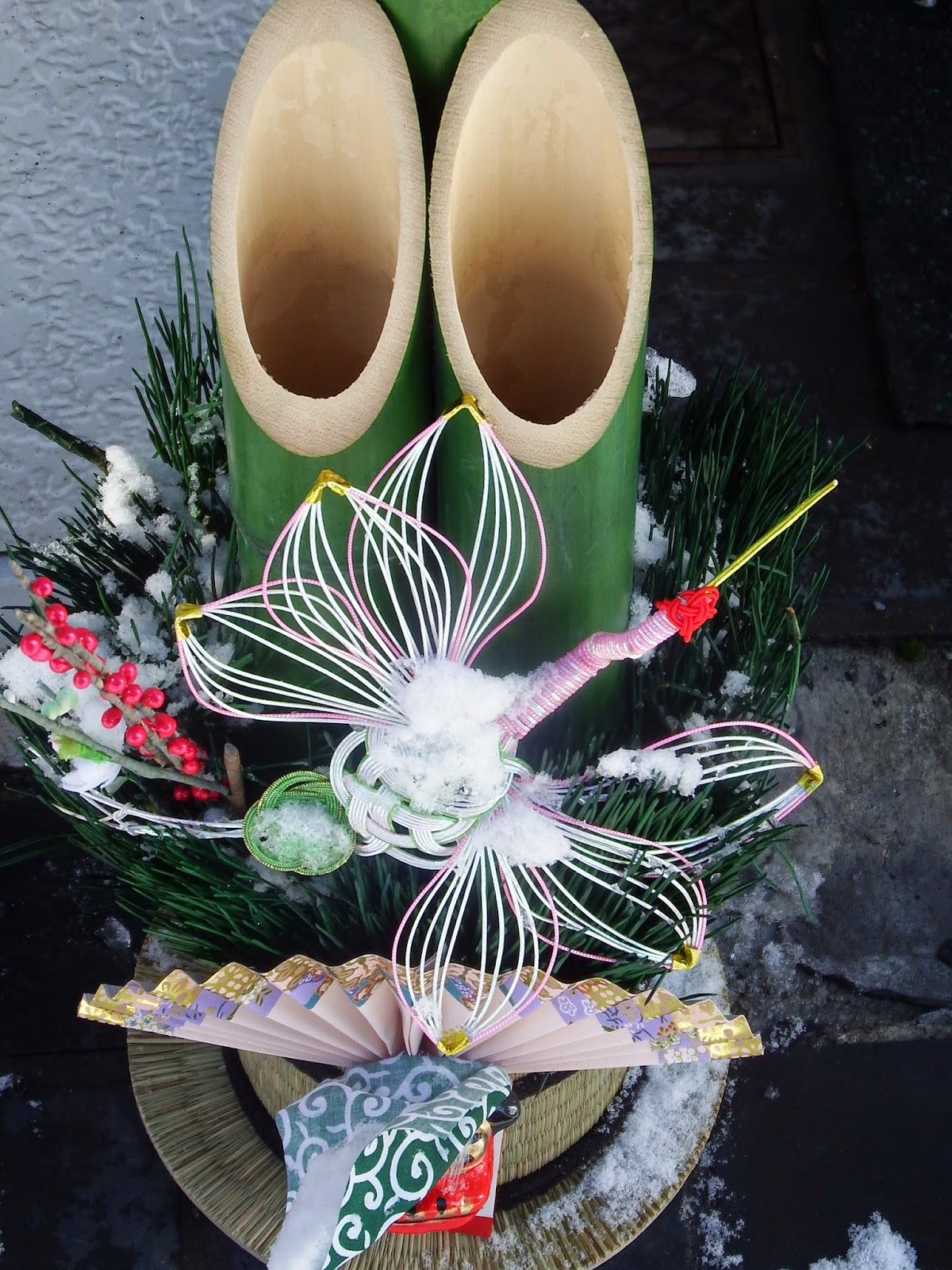
Kadomatsu, big and small, are also a major part of welcoming the new year. Bamboo and pine branches are the most common elements because to the Japanese, these "ever-greens" symbolize eternal life.



Tai, for example, are giant carp and symbolize good fortune.


Shimekazari are all beautiful and unique. Some people make them for themselves, while most people buy them from retailers. Even at the Daiso you can get a small but functional shimekazari. But no matter what you pay, or even how you display them, they hold their own...
...even if it's just a spray of pine needles.
Businesses close for about five days at the start of the year so that family members can celebrate and be with their loved ones.
Kadomatsu, big and small, are also a major part of welcoming the new year. Bamboo and pine branches are the most common elements because to the Japanese, these "ever-greens" symbolize eternal life.
Subscribe to:
Posts (Atom)